

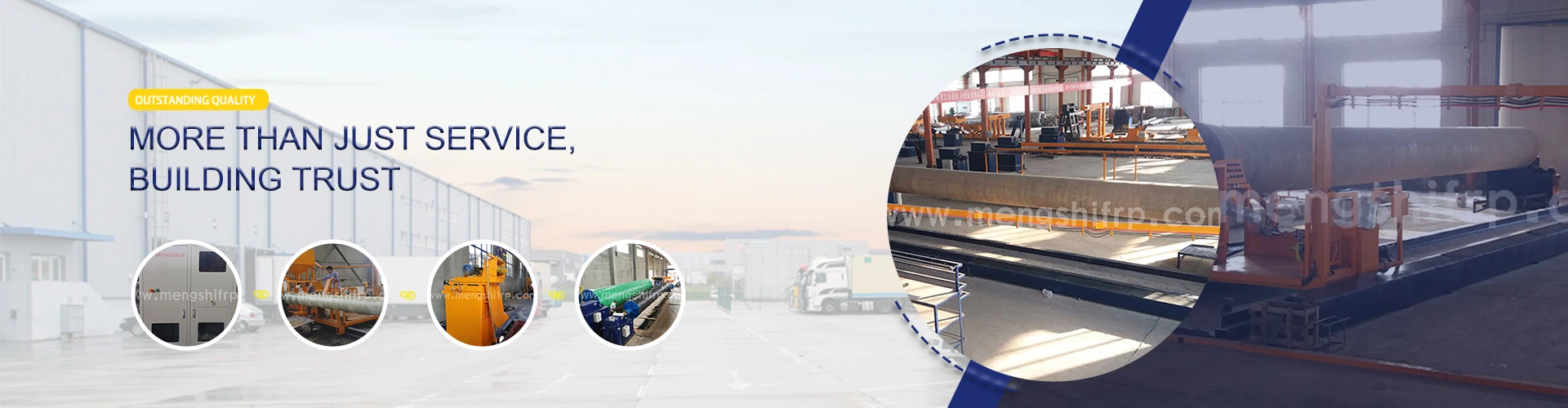
Filament Winding Equipment is core forming machinery for manufacturing hollow composite parts such as pressure vessels, hydrogen storage tanks, pipes, and rocket cases. Its working principle involves winding resin-impregnated continuous fibers (glass fiber, carbon fiber, aramid fiber, etc.) onto a rotating mandrel according to preset patterns, which are then cured layer by layer to form high-strength structural components. By number of controlled axes, machines range from 2-axis to 6-axis models, with higher axis counts enabling more complex winding patterns and part geometries.
Technology Evolution Trends
Current technology development in Filament Winding Equipment shows three clear directions. First, multi-axis interpolation and robotization, with 8-axis interpolation combined with 6-axis robotic arms already used for wet and towpreg winding, enabling complex irregular part forming that traditional 3-axis equipment cannot achieve. Second, multi-head collaborative winding, where dual-head or multi-tow synchronous feeding reduces winding time by 44% to 65% while maintaining 100% coverage rate. Third, high-speed dry winding processes, with some equipment achieving independent servo drive per single tow and increasing feed speed from 2 m/s to 5 m/s.
Selection Considerations
When purchasing Filament Winding Equipment, it is advisable to comprehensively evaluate axis configuration, tension control precision, software simulation capability, and upgradeability, rather than focusing solely on unit price. Tension control is a critical indicator, with some models achieving single-tow tension servo control as low as 1N to ensure uniform fiber layup. In terms of software, winding pattern design and G-code generation capability directly affect process debugging efficiency. Additionally, whether the equipment supports multiple processes including wet winding, towpreg dry winding, and prepreg tape dry winding determines the breadth of its application range.
Application Fields
Pressure vessels and hydrogen storage tanks are currently the fastest-growing segments, particularly Type III and Type IV hydrogen storage cylinders. Additionally, this equipment is widely used in aerospace tube and casing manufacturing, FRP pipe production, and automotive structural preform fabrication. With the continued advancement of the hydrogen energy industry and lightweighting demand, market demand for Filament Winding Equipment is expected to maintain steady growth.