

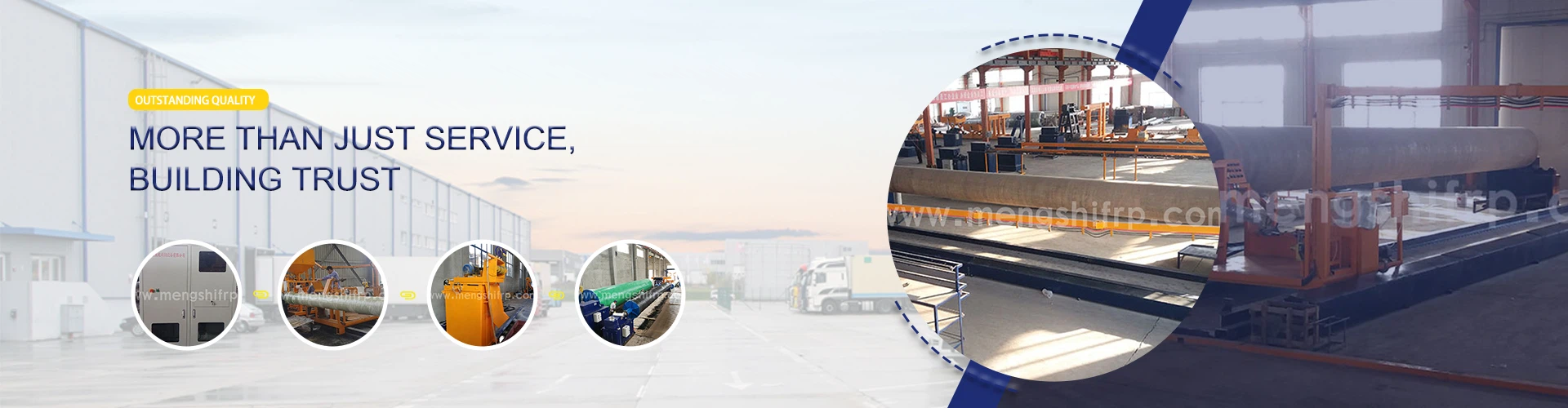
Filament winding is not only a turning mandrel and moving yarn. The final product depends on the relationship between mandrel speed, carriage travel, winding angle, fiber tension, and resin wet-out. When these items are adjusted only by manual habit, the surface may show uneven bands or loose fiber. Computer control gives the operator a clearer way to set product data and repeat the same movement on each cycle.
In the reference pipe equipment, the control system can work with manual, semi-automatic, and automatic modes. For pipe winding, the listed winding angle is 50° to 90°, and the fiber arranging accuracy reference is ±1 mm. These values show why the control cabinet is not a decoration. It links the mold rotation with the carriage movement, so the fiber path follows the set design instead of changing with each operator.
Computer control is also useful when a line has several process sections. The operator can check winding data, product size, and running state from one area. For epoxy pipe lines, the process may also include inner steam heating, water cooling, demolding, pipe end cutting, thread molding, and pressure testing. Better control at the winding step helps the later steps run with fewer corrections.